July 2025

Showing 1-10 of 4016 stories

Sort by
Categories

Year

Author / Contributor

Region

XinjiangTop_Improv_SMALL
Launched on November 17, 2024Updated with new materials regularly TFF Board members Thore Vest. Everywhere, the delegation was met with a sincere wish to develop knowledge, dialogue, cooperative projects, and initiatives based on citizens’ diplomacy – in general, but with the West in particular. For more, see “Report from the Nordic delegation to China’s Xinjiang Province, September 7-15, 2024.” While the delegation was in Xinjiang, various ideas were already being discussed from the local to the top level, i.e., with the governor and party leaders of Xinjiang. The two TFF Associates suggested that TFF set up a special section – in addition to its “China and Silk” – where various quality materials about Xinjiang would regularly be published to promote public education about Xinjiang, particularly its contemporary development – worldwide but in the West in particular. This is now a reality – as can be seen below – but it...
1909566946
The text below was published in “The Nation” on July 15, 2025, appears here unmodified. The delay is due to a weak Internet here in Turkey. There has been much critical reaction to this US Government defamatory statement justifying the imposition of sanctions on this exceptional independent expert appointed by the UN to an unpaid position, and left to hang in the wind by the politically motivated show of indifference by the UN Secretariat.] Justifying US Sanctions US Secretary of State, Marco Rubio, in a dazzling Orwellian display inverted reality by slapping sanctions on Francesca Albanese, the much-embattled UN Special Rapporteur for the Occupied Palestinian Territories of East Jerusalem, West Bank, and Gaza. If the sanctions are implemented against this extraordinary citizen of Italy, in the face of strong UN objections, Albanese will be barred from entering the US, presumably even to discharge her annual UN duty to present a...
Oppo
Photo Jan Oberg China has recently garnered significant attention due to its advancements in various technological fields, such as quantum physics and artificial intelligence. In media discussions and my lectures on China, it is common to encounter objections asserting that the West, particularly the United States, is certainly ahead of China. These assertions appear to be more emotional than factual. However, a more fundamental consideration is whether this question holds any significance. Cultural Perspective One aspect that Westerners often overlook is the cultural variation in understanding the relationship between abstract academic insights and practical applications of those insights. To comprehend the origin and significance of discussions on technological superiority, it is essential to acknowledge cultural and social differences between China and the West. I have explored this topic before in some of my previous articles published on the TFF website. Particularism On the cultural dimension universalist – particularist, China exhibits...
shahab-zolfaghari-T7N5U9kpNIk-unsplash-1
Photo by Shahab Zolfaghari on Unsplash When we speak about “transition”, some people believe that in fact there is no need for transition and everything will remain as it is forever. Of course, transition is not a precise term and each person can have his/her own interpretation of the term. The way that I interpret this term, transition means moving from one state to another. History has shown us that nothing, not even the most powerful regimes, such as that of the late Shah or even the British or French empires or the Soviet Union or, dare I say, the current US empire whose decline is being accelerated as the result of the current xenophobia, bullying, chaos and lawlessness, will remain forever. Sooner or later, they will be thrown into history’s dustbin. In the case of the Islamic Republic, even some of its former friends and supporters have openly concluded...
Bases-Report-2025
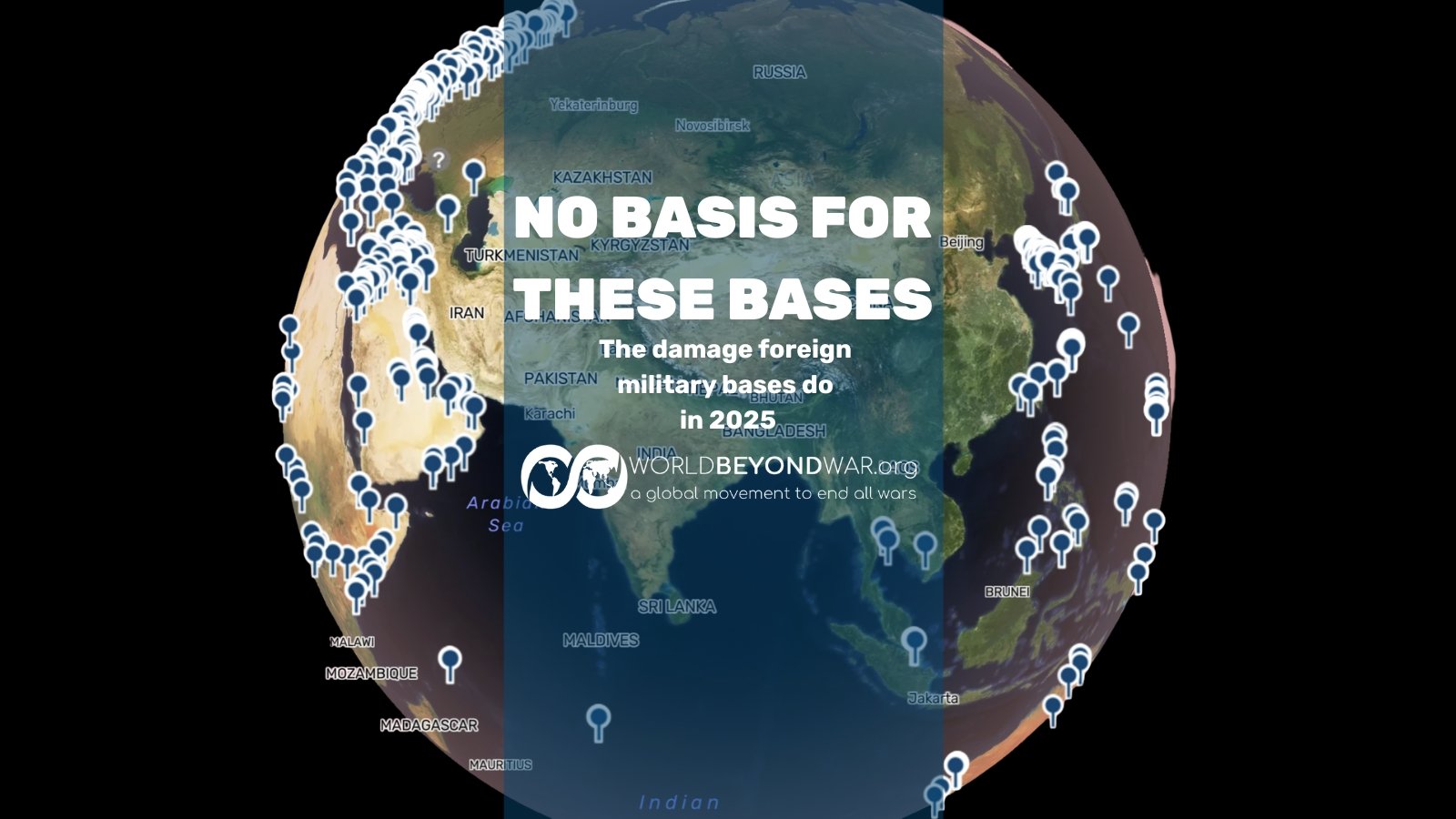
By World BEYOND War A new report by the global peace group World BEYOND War finds that military bases used by foreign militaries are growing in number, as are public protests and advocacy against those bases. Of 1,247 foreign military bases in the world, 877 of them, by latest count, are U.S. bases outside of the United States. Eighteen other nations, combined, have 370 bases outside their borders. The full report is available at https://worldbeyondwar.org/basesreport2025 While U.S. bases are in 95 foreign countries all over the globe and virtually encircling the borders of Russia and China, the nation with the second-most foreign bases, Türkiye, has them all near Türkiye, with the exception of one base in Somalia, and the majority of them in Syria and Iraq where Türkiye has been waging wars. During U.S. wars in Iraq and Afghanistan, the United States added, and later closed, hundreds of bases. Türkiye and...

gandhi21
0,”href”:”https://transnational.live/wp-content/uploads/2025/07/Gandhis-Philosophy-of-Nonviolence-1.pdf”,”displayPreview”:true} –> Gandhis-Philosophy-of-NonviolenceDownload
Eclecticism_90cm_300dpi_1200_100dpi
Foreword The Board of The Transnational Foundation in Sweden has decided to publish an easy-to-read, scholarly anthology that addresses one of the most important – and potentially dangerous – issues of our time: Why are the political, economic, and medialised Western images of China so consistently negative – and what can you do to understand China better? These images may be expressions of a political will to present only various shades of grey and black with the aim of building a consciousness about China as an enemy and not a partner. They may also be seen as a sort of world-dominating ethos of ignorance based upon the assumption that “we’ve-got-nothing-to-learn-from-others,’ we are the teacher. Another possibility is that the West, deep down, feels that it is getting relatively weaker from a macro-historical perspective and comforts itself with denial and accusations against “the other” of being the reason for its manifest...