March 2021

Showing 1-10 of 4016 stories

Sort by
Categories

Year

Author / Contributor

Region

mosul2_2.jpg
U.S. bombs and bullets have claimed at least hundreds of thousands of civilian lives this century. Here, a U.S. airstrike against Islamic State militants in densely-populated Mosul, Iraq on July 9, 2017 is shown. (Photo: Ahmad Al-Rubaye/AFP/Getty Images) March 29, 2021 Medea Benjamin, Nicolas J.S. Davies Unbeknownst to many Americans, the U.S. military and its allies are engaged in bombing and killing people in other countries on a daily basis.  On February 25th, President Biden ordered U.S. air forces to drop seven 500-pound bombs on Iraqi forces in Syria, reportedly killing 22 people. The U.S. airstrike has predictably failed to halt rocket attacks on deeply unpopular U.S. bases in Iraq, which the Iraqi National Assembly passed a resolution to close over a year ago.  The Western media reported the U.S. airstrike as an isolated and exceptional incident, and there has been significant blowback from the U.S. public, Congress and the world community, condemning the strikes...
AdobeStock_142976117
Image: Adobe Stock / XY March 23, 2021 Jedediah Britton-Purdy, Amy Kapczynski, David Singh Grewal If we are to emerge from this era of crisis, we need legal thinking that operates on fundamentally different presumptions. We live in an era of intersecting crises—some new, some old but newly visible. At the time of writing, the COVID-19 pandemic has already caused nearly 500,000 deaths in the United States alone, with many more deaths on the horizon in the coming months. Since its arrival in the United States, the virus has intersected with and magnified long-neglected problems—radical disparities in access to healthcare and the fulfillment of basic needs that disproportionately impact communities of color and working-class Americans, alongside a crisis of care for the young, elderly, and sick that stretches families and communities to the breaking point. Originally published at Bostonreview These crises arise from the chronic failure of political institutions to respond...
Increased Security Remains Around Capitol Hill In Washington, DC
It’s no coincidence that, after years of fighting abroad, the United States is beset with paranoia, loss of trust, and increasingly bitter divisions Stephen M. Walt March 16, 2021 “Fortress America” is a derogatory term that usually refers to extreme forms of isolationism. Last week, however, CNN anchor Fareed Zakaria gave the idea a new and equally disturbing twist. In a thought-provoking column in the Washington Post, Zakaria described how excessive concerns for security are making the United States more “imperial” in appearance than the old colonial empires, with embassies, public buildings, and even the U.S. Capitol itself surrounded by barricades, moats, or fortifications. Instead of presenting a welcoming visage to the outside world and to the American people, one that conveys confidence, strength, and openness, America’s public face appears uncertain, vulnerable, fearful, and distant. Originally published at Eurasia News Online According to Zakaria, such concerns have also encouraged an excessive regard for secrecy,...

Screen-Shot-2017-12-04-at-8.55.14-PM
Photo by Daniel Huizinga | CC BY 2.0 Gabriel Rockhill  March 16, 2021 One of the most steadfast beliefs regarding the United States is that it is a democracy. Whenever this conviction waivers slightly, it is almost always to point out detrimental exceptions to core American values or foundational principles. For instance, aspiring critics frequently bemoan a “loss of democracy” due to the election of clownish autocrats, draconian measures on the part of the state, the revelation of extraordinary malfeasance or corruption, deadly foreign interventions, or other such activities that are considered undemocratic exceptions. The same is true for those whose critical framework consists in always juxtaposing the actions of the U.S. government to its founding principles, highlighting the contradiction between the two and clearly placing hope in its potential resolution. Originally published at Counterpunch The problem, however, is that there is no contradiction or supposed loss of democracy because the United...
Screenshot
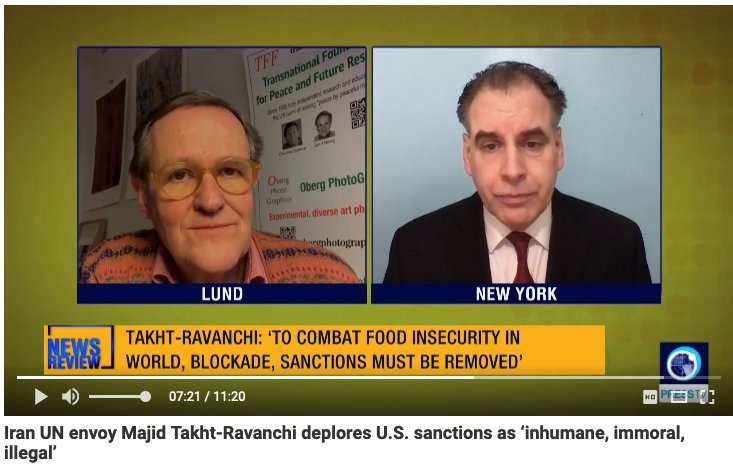
Jan Oberg and John Bosnitch March 13, 2021 Today I had the pleasure to state my strong criticism of the ongoing brutal sanctions Western primary and secondary sanctions on Iran which deliberately hit Iranian citizens and can, therefore, be termed economic terrorism. Terrorism differs from warfare in that they target innocent civilians to achieve a political goal: “Terrorism is, in the broadest sense, the use of intentional violence to achieve political aims. It is used in this regard primarily to refer to violence during peacetime or in the context of war against non-combatants (mostly civilians and neutral military personnel)” – to quote the entry at Wikipedia. I was pleased to do so with John Bosnitch, a Canadian-born journalist and scholar of Serb origin, now living in Belgrade – a place where they know Western sanctions very well too. See the conversation here on PressTV. You may be interested in reading...
Whaam! 1963 by Roy Lichtenstein 1923-1997
Whaam! 1963 is a large, two-canvas painting by the American pop artist Roy Lichtenstein that takes its composition from a comic book strip. What would the world be like if the U.S. lost control globally? Chalmers Johnson (1931-2010) March 17, 2021 In 1962, the historian Barbara Tuchman published a book about the start of World War I and called it The Guns of August. It went on to win a Pulitzer Prize. She was, of course, looking back at events that had occurred almost 50 years earlier and had at her disposal documents and information not available to participants. They were acting, as Vietnam-era Secretary of Defense Robert McNamara put it, in the fog of war. So where are we this August of 2010, with guns blazing in one war in Afghanistan even as we try to extricate ourselves from another in Iraq?  Where are we, as we impose sanctions on Iran...
the-long-telegram-l
Natylie Baldwin March 15, 2021 February 22nd marks 75 years since George F. Kennan sent his famous “Long Telegram” to the State Department in which he provided an assessment of the Soviet Union that led to the U.S. containment policy of the Cold War. The Cold War, in turn, saw various conflicts, scores of covert operations, regime changes, and a nuclear arms race.  Conventional wisdom generally has it that Kennan’s assessment of the Soviet government was accurate.  But was it?  And if it wasn’t accurate, why has it been treated as a brilliant analysis that underpinned a policy still characterized as an inevitable necessity? In order to answer those questions, it is necessary to look at who George F. Kennan was, what the main points of his analysis were and how they have held up to the historical facts, as well as the political context in which his assessment was...
PeaceResearchProblem
Photo collage © Jan Oberg 2021 Researchers who question the legitimacy of US wars, seem to experience being ousted from their positions in research and media institutions. The example presented here is from the Institute for Peace Research in Oslo (PRIO), an institution that historically has had researchers critical of wars of aggression – and who can hardly be labelled friends of nuclear arms. Ola Tunander, Research Professor Emeritus at PRIO Originally published in Norwegian by “Modern Times/Ny Tid”, Whistleblower supplement, March 1, 2021 A researcher is said to seek objectivity and truth. But he or she learns to select their research topics and arrive at conclusions in accordance with what the authorities and management expect, and this despite the fact that academic freedom is codified in Norway through the “freedom to express oneself publicly”, “freedom to promote new ideas” and “freedom to choose method and material». In today’s societal...
RichardFalk
TFF Associate and friend over decades, Richard Falk, last year turned 90. Read more about him here – and use the search engine to find lots of his writings. The latest we’ve published is on championing lost causes... Eric Walberg March 10, 2021 Writing this memoir has been as much about discovering my story, that is, myself as it is about telling it. That’s Falk’s version of Socrates’ ‘the unexamined life is not worth living.’ Or should I say, Forrest Gump’s? Falk’s life reads like a storybook, starting with meeting Supreme Court judges with his father at age 9 in 1939, making friends with Claudette Colbert, Zsa Zsa Gabor, Liz Taylor (long story) at age 15, befriending and befoeing many of the dramatis personae of the Cold War throughout his long and productive life, finally landing on the shores of democratic socialism as the US charges towards the (literal) finish line. Falk came...
Mahatma-Gandhi-ph-Rajni-Kothari
(Mahatma Gandhi, ph. Rajni Kothari, photo credit: Wall Street International) March 2, 2021 Ashish Kothari In a world that is increasingly torn by conflicts and crises of many kinds. On October 2, political and business and religious leaders in India and elsewhere remember Mahatma Gandhi, sing his praises, and pledge to live by the ideals he espoused. A day later, or perhaps the same evening, he is left behind as suddenly as he was remembered that morning. Worse, they get back to assassinating him and the ideals of non-violence, self-reliance, universal well-being, that he lived and died for. And yet it is worth asking: in this 151st birth anniversary month, does he still hold relevance in a world that is increasingly torn by conflicts and crises of many kinds? Originally published by Wall Street International Interestingly, over the last few years there appears to have been a rekindling of attention to...
albert-einstein-05-1170x670-1
Albert Einstein February 27, 2021 (Originally published in May 1949) Is it advisable for one who is not an expert on economic and social issues to express views on the subject of socialism? I believe for a number of reasons that it is. Let us first consider the question from the point of view of scientific knowledge. It might appear that there are no essential methodological differences between astronomy and economics: scientists in both fields attempt to discover laws of general acceptability for a circumscribed group of phenomena in order to make the interconnection of these phenomena as clearly understandable as possible. Originally published by Monthly Review But in reality such methodological differences do exist. The discovery of general laws in the field of economics is made difficult by the circumstance that observed economic phenomena are often affected by many factors which are very hard to evaluate separately. In addition,...
human-rights-hands
The United States, Britain and European nations have a history of ‘weaponising’ human rights in foreign policy. Throughout late imperial history, China has rarely blamed other nations, their religion or race, for domestic problems. Martin PowersAn opinion piece in South China Morning PostMarch 4, 2021 The term “human rights” is properly a feature of the modern world, but people have been calling out cruelty for centuries. Who gets blamed for human tragedy reveals a lot about how a nation values human life. Western nations, chief among them the United States, have long assumed the promotion of human rights as one of their natural duties, but in recent years some have questioned their qualifications for doing so. Last Fall in the journal Foreign Affairs James Goldgeier and Bruce W. Jentleson itemised the failures of America’s “tarnished model”, taking note of that “internationally controversial war in Iraq” and a major financial crisis in 2008. Following a...