June 2014

Showing 1-10 of 5204 stories

Sort by
Categories

Year

Author / Contributor

Region

octagon1-300x210
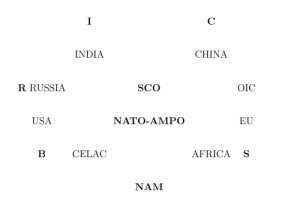
Time to take stock. The shot in Sarajevo 100 years ago inspires narratives of 19-year old Gavrilo Princip killing the successor to the throne of an empire and his pregnant wife as the event unleashing mutual mass murder (INYT, FAZ 28-29 June 2014). Not the empire annexing Bosnia-Herzegovina on October 6, 1908 (Art. 25 of the 1878 Berlin Congress of “great powers”). Maybe the inhabitants did not like it? Moral of that stock-taking: watch out for terrorism, not for empires and occupation-colonialism; and protect leaders, not people. ISIS (Islamic State of Iraq and the Levant, alternatively translated as Islamic State of Iraq and Syria and Islamic State of Iraq and al-Sham) comes up. TIME 30 June: The End of Iraq. Maybe Iraq – that highly artificial English colonial entity encasing Shia Arabs, Sunni Arabs and Sunni Kurds–never started? Like its French colonial neighbor Syria – adding Alawite Arabs, Christians, Jews...
janoberg
/10/janoberg.jpg”> Both NATO and the EU has just announced that their members will now invest more in the military. It’s indicative of the lack of creativity in both organisations, it is self-defeating and counter-productive. But have you seen it put on top of any agenda and debated? You haven’t, it is so normal – and the argument is that we are threatened. That’s called fearology: Making tax payers pay even more by making them scared. The military sector is a parasite on society The military sector produces much less employment than the civilian per invested dollar. It’s a huge burden on the economy because it swallows creativity, research and development badly needed to solve humankind’s real problems. Weapons don’t belong to a market, there is no competition – the state is the only buyer – and thus tax payers must cover the systematic cost overruns. We are told that there...
jonathanpower2
/10/jonathanpower2.jpg”> War is all over the place. It seems. Not just Syria and Iraq but now inside Pakistan. Not to mention Somalia and Sudan. Yet paradoxically there has never been less war. Sweden’s Uppsala University Conflict Data program is about to publish its results for 2013. It reports that the number of conflicts in the world increased by one between 2012 and 2013 – pace all the press and TV coverage which sometimes gives the impression that half the world is going up in smoke. Since the Cold War ended the number of conflicts claiming more than 1,000 deaths has declined by 50%. There were 15 conflicts of this size in the early 1990s. Today there are only seven. In 2013 six peace agreements were signed – which is two more than the year before. The number of democratic countries was 69 at the end of the Cold War. Today...
johangaltung
By Johan Galtung Alfaz; History group, Municipio, Spain Can we know the future? Rhetorical answer: can we know the past? We rewrite history all the time, not because facts become dubious and new facts appear, but because our angle, perspective, changes. Say, from a series of kings, presidents etc. and their exercise of military and political power to economic and cultural changes in the life of common people, in their wellbeing and identity. Quite some change. Will we arrive at that single, true, objective perspective? No, objectivity may be multi-subjective, not inter-subjective. This is why Al Jazeera is so much better for knowing the present than CNN, which presents the US angle, and if there are other angles a US “expert” will give the final interpretation. Al Jazeera presents many angles of many parties and leaves final interpretations to the viewer. How can we shed some light into the future?...

jonathanpower2
/10/jonathanpower2.jpg”> June 17th 2014 Is it “you reap what you sow”? The US electorate that voted twice for President George W. Bush should ask itself the question. The growing strength of ISIS and Jabhat al-Nusra, represents a grave threat to the future of the Middle East and the US has no one to blame but itself. ISIS (The Islamic State of Iraq and al-Sham), it is being said, could eventually reconfigure the Middle East if it is able to seize significant chunks of Iraq and Syria, the Arab world’s two strategic centrepieces, spanning the Mediterranean to the Persian Gulf. ISIS has begun setting up a proto-state in parts of Syria and Iraq, with its own courts, police and public services. According to the well-informed Middle East watcher, Robin Wright, “ISIS has become the most aggressive and ambitious extremist movement in the world. It is also the most deadly and the...
richardfalk
Palestine Hunger Strike and Israeli Force-Feeding Pending Legislation The highly respected Israeli human rights NGO, Adalah, has issued an urgent appeal on behalf of a reported 125 Palestinian prisoners who are engaged in a hunger strike protesting their being held in Israeli jails on the basis of ‘administrative detention’ procedures. It is the longest collective hunger strike in Palestinian history. Administrative detention is an objectionable practice by which individuals are held in prison, sometime for months or even years, without being informed of charges or facing trial. According to international law reliance on administrative detention is regarded as prohibited unless there are overwhelming reasons in the form of imminent and severe security threats to justify the failure to produce criminal charges and hold a trial. Israel has made no such appeal, and appears to use administrative detention procedures routinely and against individuals who cannot be considered security threats. The current...
jonathanpower2
/10/jonathanpower2.jpg”> In recent months the scare-mongers have been at it again – Russia’s foray into Ukraine and China’s behaviour in the South China Sea have set their alarm bells ringing. But why? Big power politics is not back. Indeed in the round it is rather subdued. Take the Russian-EU-US fracas over Ukraine at the moment. Does this compare with the Cold War when the West prepared itself for a Russian invasion of Europe, nuclear missiles were targeted on each other, and when the Soviet Union along with the US stirred up proxy civil wars in Central America and Africa? Do the US and NATO fear such threats as these today? Of course not. Critics of President Barack Obama and denigrators of President Vladimir Putin badly need a sense of perspective.
johangaltung
B Pretoria, South Africa, Keynote Governance is politics, power–political-economic-military-cultural; decisions-carrots-sticks-ideas. Politics is about problems of realizing one goal; about conflicts realizing incompatible goals. Contradiction = danger+opportunity; the art of the impossible. Answer: Good Governance GG = CC Creative Conflict-transformation. This includes diagnosis, who are the parties, their goals and the incompatibilities; prognosis, from frustration to aggression/apathy, from prejudice-discrimination to hatred-violence; therapy, conflict solution-transformation, proposing creative visions of a new reality where the goals are compatible and new conflicts more easily handled. Two examples of creative, good governance from Norway and Europe:
richardfalk
A major undertaking of the victorious powers in World War II was to impose individual criminal accountability upon political and military leaders for alleged crimes committed during wartime before a tribunal convened by the victors that gave those accused a fair opportunity to present a defense. This application of this idea of accountability to German and Japanese surviving leaders at trials held in Nuremberg and Tokyo was hailed at the time as a major step in the direction of a ‘just peace.’ International law was treated as binding upon sovereign states and those that represented the government, conceived to be a major step in the direction of a global rule of law. The final decisions of these tribunals also produced a narrative as to why World War II was a necessary and just war. Such an outcome was both a vindication of the victory on the battlefield and a punitive...
stephenzunes
By Stephen Zunes and Erica Chenoweth May 28, 2014 – Published at foreignpolicy.com Ukraine faces a rising tide of violence in the restive east. Here’s why nonviolent activism is the best strategy for fighting back. On May 15, thousands of unarmed residents and steelworkers of the eastern Ukrainian city of Mariupol did nonviolently what a bloody attack by Ukrainian troops six days earlier was unable to: rid the region’s second-largest city of armed pro-Russian separatists who had held key buildings and other parts of the city for weeks. Smaller protests have taken place in other cities in eastern Ukraine held by separatists. In the eastern cities targeted by armed pro-Russian militias, such as Donetsk, Lugansk, and Krivy Rig, large nonviolent protests in support of national unity have taken place in recent weeks. Continue here. Originally published here.
janoberg
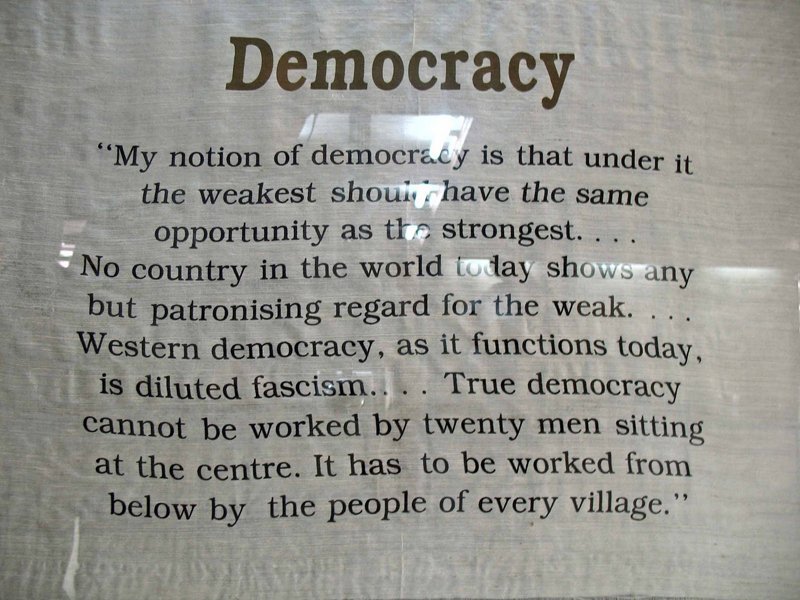
/10/janoberg.jpg”> Democracy is a core feature of Western society, normally understood as representative parliament – i.e. in free elections citizens vote for people to represent their interests for a parliament consisting of parties of which some form the government and some the opposition. It’s not always included in the definitions that democracy requires a reasonable level of knowledge and information, freely available. For instance, one often hears that India is the world’s biggest democracy but 26% of the people are still illiterate (287 million people). So the ”world’s largest democracy” also has the world’s largest population who can’t read and write. In comparison, China illiterate citizens make up about 3% and is regularly called a dictatorship. Also, in a society where the persons running for office are – or have to be – extremely wealthy to pay for their campaign and where large corporations make multi-million dollar contributions to certain...
Gandhi-On_DemocracyFascism2
/10/janoberg.jpg”> Lund, Sweden, June 3, 2014 Fears has been expressed in Europe about the recent EU parliament voting pattern. Instead of the fear and denouncing the winners we should ask: What causes such an outcome? My short answer is this: Democracy itself is in deep crisis. It has become performance or ritual rather than something genuinely lived. Two things stand out – one, the increase in votes going to nationalist, populist, right-wing and anti-Muslim parties as well as Euro-skeptics – particularly in Denmark, France, Greece and Britain. Secondly, the voter turnout has fallen from 62 per cent in 1979 to 43% in 2009 and this year it increased only 0.09% in spite of the EU Commission’s attempt to increase it. So while people struggle around the world for democracy, only 43% of the EU citizens find it meaningful to go and vote every 4th year. How tragic for an EU...