May 2014

Showing 1-10 of 4199 stories

Sort by
Categories

Year

Author / Contributor

Region

janoberg
/10/janoberg.jpg”> Lund, Sweden – May 29, 2014 In a speech by the President of the United States of America – read by millions in all corners of our world in minutes – rest assured that every single word has been weighed with utmost care. With this in mind, Obama’s speech can be analysed as both offending to the rest of us and – exceptionally – weak. It caused no enthusiasm among the future army officers he spoke to and no enthusiasm among leading Western media. I will argue that • Intellectually and morally the speech doesn’t have the basics – full of contradictions and imbued with unbearable self-praise. • While there is a recognition of ”mistakes” such as ”our” war in Iraq and a potential step-back from interventionism, there is neither an adequate analysis of the past nor of what the future may need in terms of leadership. • Little...
richardfalk
Pope Francis’ visit to the Holy Land raises one overwhelming question: What is the nature of religious power in our world of the 21st century? Can it have transformative effects’? Media pundits and most liberal voices from the secular realm approve of this effort by Francis to seek peace through the encouragement of reconciliation, while dutifully reminding us that his impact is only ‘ceremonial’ and ‘symbolic’ and will not, and presumably should not, have any political consequences beyond a temporary cleansing of the political atmosphere. The June 6th prospect of Mahmoud Abbas and Shimon Peres praying together in the Vatican as a step toward a peaceful end of the long struggle is, I fear, an ambiguous sideshow. For one thing, Peres as President of Israel is about to leave the office, and in any event, his position exerts no discernible influence on the head of state, Benjamin Netanyahu, or the...
jonathanpower2
/10/jonathanpower2.jpg”> Who makes foreign policy in the US government? Ultimately the president. That goes without saying. But who has his ear? Sometimes the eminence grise becomes well known – a star like Henry Kissinger who crafted policies that put the flesh – and blood – on Richard Nixon’s foreign policy. Others become an intimate but out-of-the-limelight counsellor, like Brent Scowcroft with George Bush senior. Others like Barack Obama’s two secretaries of state, Hillary Clinton and John Kerry, are strong voices in the Administration but are not in the White House’s self-effacing inner circle. Obama makes the foreign policy himself, although in his early days, unaccountably, he allowed the military to make his policy in Afghanistan. Perhaps the most perfect of relationships was between President Jimmy Carter and Zbigniew Brzezinski, his national Security Advisor. It was an unusual union between a southern “born again” Christian and a sophisticated academic who had...
richardfalk
[ This post was previously published online at the website of the Global Transition Initiative, which is dedicated to promoting “Transformative Vision and Praxis.” It responds to an essay on global citizenship written by Professor Robert Paehlke, who cogently advocates the formation of a Global Citizens Movement, including indicating how it might become effective. What seems important about such dialogue is the recognition that given the realities of this historical period, it is increasingly necessary for political thought and action to proceed by reference to human interests as well as being responsive to national, local, ethnic, and religious interests and values. A feature of modernity that is being rightly questioned from many angles is the presumed radical autonomy of human interests, especially the modernist illusion that the co-evolutionary dependence on nature and the environment was being superseded by the marvels of technological innovation. One way back to the future is...
GaltungTable
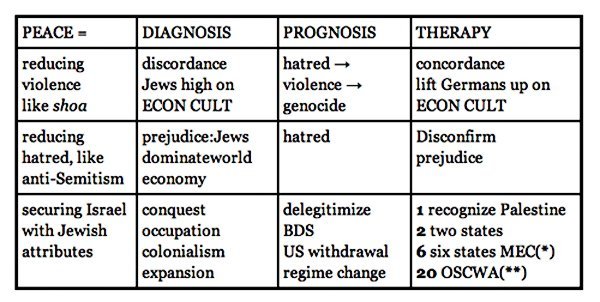
Foreign Policy Studies, University of Malmö, Sweden Thanks for wanting a summary of key points in “Galtung Peace Studies”. I was just honored with a “Lifetime Award” by world sociology, 60+ years; in short, time for summary with an author’s caveat: no substitute for reading books. [1] 1951: Peace studies=peace theory+peace practice; applied science, with an explicit value–peace–with practice-indicative theories and theory-testing practice; like health studies, unlike social sciences. Model: peace to violence as health to illness; Diagnosis-Prognosis-Therapy produced health by weakening pathogens-strengthening sanogens; try the same for peace by weakening bellogens-strengthening paxogens. Mantra: through interdisciplinary, international, interlevel research. [2] Like in illness violence=suffering of body-mind-spirit, also of the bereaved; unlike in illness, an intended act of commission, a perpetrator-victim relation, a crime, epitomized by aggressive war. Body wounds may be healed but stigma, shame, humiliation, hopelessness, hatred, fear, revenge may settle in mind and spirit as trauma. To judicial...

janoberg
Av Jan Öberg Lund , Sverige – 23 maj 2014 Tiden för rationell politik, om begreppet någonsin funnits, är över . ”Realpolitik” har blivit en blandning av marknadsförda ord, propaganda och ledare som gör uttalanden som gränsar till absurd teater. Tunnare och tunnare länkar till Realiteten. Detta är vad som händer när man förnekar nedgången. Alla imperier går ner. Det amerikanska imperiet är på nedgång. Makrohistoriker (se t.ex. British Arnold Toynbee’s 12–volymarbete 1934-1961) berättar att det finns många skäl till att imperier faller: • militarism med konstant krigföring; • överutvidgning – försöka kontrollera mer än vad du kan hantera; • förlust av legitimitet i andras ögon; • strukturella ekonomiska kriser; • moraliskt förfall; • förlust av intellektuell och teknisk innovation; • andra maktstrukturer ökar i styrka över tid och göra saker på nya, kreativa sätt . Efter 1945 ansågs USA vara starkt på en rad olika maktdimensioner: militär, ekonomi, politik,...
janoberg
/10/janoberg.jpg”> Lund, Sweden – May 23, 2014 The time of rational politics, if it ever existed, is over. ”Realpolitik” has become a mixture of marketing soundbites, propaganda and leaders making statement that borders on the Theatre of the Absurd. Thinner and thinner links to Real-ity. This is what happens when decline in being denied. All empires go down. The U.S. empire is in decline. Macro historians (see e.g. British Arnold Toynbee’s 12-volume work 1934-61) tell that there are many reasons when empires fall: • militarism with constant warfare; • overextension – trying to control more than you can manage; • loss of legitimacy in the eyes of others; • structural economic crisis; • moral decay; • loss of intellectual and technological innovation and • simply other powers gaining strength over time and doing things in new, creative ways. After 1945 the U.S. was considered strong on many power dimensions: military,...
gunnarwestberg
By Gunnar Westberg The Mouse that roared was a much acclaimed movie comedy from 1955 in which a small European Duchy tried in vain to get the attention of the USA for a trade conflict. To get the attention of the mighty superpower the Duchy finally declared war on the USA. And to its surprise, won! The story to be told below is less funny. The Minister of Foreign Affairs for the Marshall Islands, Mr. Tony de Brum, spoke at the recent conference on the treaty against nuclear weapons, NPT, in New York. He remembered his experience of nuclear weapon tests in his childhood: – “I have witnessed nuclear weapon explosions and my memories from the Lipiep atoll in Northern Marshall Islands are strong. I lived there as a boy during the 12 years of nuclear testing. I remember the blinding white light from the Bravo test on the Bikini...
jonathanpower2
/10/jonathanpower2.jpg”> May 20th 2014. Who makes the law of the sea as China and Vietnam clash over China moving an oil rig close to an island only 25 miles from the mainland of Vietnam? One would hope that China which has ratified the Law of the Sea Treaty which has, among its other virtues, an arbitrating court for such disputes, would seek international, but disinterested arbitration. It refuses to. Has this got something to do with the fact that the US has not ratified the Treaty? The Chinese don’t say so explicitly, but if the world’s one and only superpower refuses to sign up why should China pay the Treaty due regard? Is that what China is thinking? It is not a very good reason, but conceivably an understandable one.
johangaltung
In Oslo, 200 Years after the 17 May 1814 Independence Constitution And why did that happen? The Treaty of Kiel 14 January 1814 between UK-Sweden of the anti-French Sixth Coalition and Denmark-Norway allied to Napoléon made Copenhagen cede Norway to Sweden. And why did that happen? Because Russia with unspeakable suffering had won the 1812 war with Napoléon–that winner of battles and loser of wars; Waterloo 18 June 1815 was still far away. All described in one of the best books ever written, Leo Tolstoy’s War and Peace (1869); written, it has been said, as if Life were the author. Norwegians used the time after the Treaty well for independence with a Constitution, before Sweden invaded and Norway capitulated: the Convention of Moss 14 August 1814. No Sweden-Norway under Stockholm, only a joint king and foreign policy, both Swedish; dissolved in 1905. And how was the gratitude expressed to Russia...
J-JNielsen_PhSh
Jens-Jørgen Nielsen became TFF Associate in May 2014 jensjorgenmeister@gmail.com Basic facts Nationality: Danish Married status: Married with 2 children to Yelena since 1992 (She is Russian, born in Estonia). Current employment: Assistant professor with Niels Brock Department for Business Studies. Besides I run my own small business as consultant in the field of managing culture clashes and conflict management and consultant for Danish export firms. Moreover I am the author of several books, the latest being: På egne præmisser – Putins nye Rusland (On its own terms – Putin´s New Russia). Date of Birth: 12.09. 1949
janoberg
/10/janoberg.jpg”> Lund, Sweden May 9, 2014 1. Welcome de-escalation Vladimir Putin’s statements that separatists should not hold referendums on May 11, that he welcomes the elections in Ukraine on May 25 and that Russia is withdrawing troops from the border with Ukraine should be welcomed. If he has been ”aggressive” and this is a ”turnabout” as many in the West believe, this turnabout is even more welcome. If he hasn’t been aggressive but merely defensive, it is still helpful in terms of defusing the crisis. 2. Constructive response from the West The only constructive approach so far seems to be OSCE chair Burkhalter’s “roadmap”. But it needs to get more concrete and detailed. We now need some constructive response from the US, NATO and EU. It would be helpful if they announced that they will not try to include Ukraine in NATO or EU for that matter but respect the...