August 2001

Showing 1-10 of 5204 stories

Sort by
Categories

Year

Author / Contributor

Region

Imagen-thumbnail-The-Transnational-1
Macedonia in NATO – NATO in Macedonia Successive Macedonian governments officially argue that the country must become a member of NATO. Macedonia is heading for NATO membership. However, since Macedonia is not yet “mature” enough to be in NATO, NATO will be in Macedonia. Macedonia has not had, or been allowed to have, an independent national security commission that could investigate various future options for the country. NATO membership is the only idea in Skopje. If there are sceptical security experts and defence intellectuals, they do not seem to speak out. The local NGOs vary in their enthusiasm; however, peace groups, women’s groups, etc who are not only sceptical but downright opposed to it have little influence. What NATO membership will cost, in money terms, in the next, say, twenty years is not analysed and there is no talk of a referendum &endash; but, of course, a lot of talk...

Imagen-thumbnail-The-Transnational-1
LONDON – It should come as no surprise to the organizers of the World Conference Against Racism that many American activists want to hijack this conference that begins in Durban on Friday to force a debate about how it is that America’s “war on drugs” has turned into an apartheid-like device that imprisons black men at thirteen times the rate of white men. I wish them luck- any effort to lift the drugs debate out of the intellectual doldrums where policy makers insist on sleeping on the facts is to be welcomed. For a society that prides itself on its innovative technological life and its rigorous political debates its attitudes to drug use are nothing less that extraordinary. Solid facts are dismissed and old prejudices are fanned into flames. America is paying a terrible price for burying its head in the sand- and in the process, because of its tremendous...
Imagen-thumbnail-The-Transnational-1
Few citizens can go to conflict regions to develop an understanding and form an opinion. Most of us rely on the dailies, the radio and television. So, the media stand between the events and each of us. What we obtain is not necessarily reality but an image of it, a part of it, some aspects and angles rather than others. In principle, it can hardly be otherwise. But what if the coverage is systematically biased and what if there is a tendency in what is not covered? Once again there is a Balkan crisis and once again some of us who have been on the ground for about ten years ask: do we have a free press on which those at home can safely rely? Here follow some 20 examples of what could have featured prominently in the headlines about Macedonia the last few months. Most citizens are likely not...
Imagen-thumbnail-The-Transnational-1
Since the beginning of the violence in Republic of Macedonia there has been an imposed “peace process” by the President of Republic of Macedonia and the “international community”. Now, when the framework Agreement for Solution of the Political and Security Crises is in its final draft, it is likely that the violence will not stop. The reasons are not solely the Agreement or the “players” who reached it. It has become obvious that the “President’s peace plan” and all the actions in the “peace process,” no matter if by the Government, the President or others, had been set on the wrong foot from the beginning. The aim of this article is to highlight some of the facts that speak about the premises and proposed solutions in the “peace process” rather than perpetuates the popular “picture” and the international image-making. That is why the concrete proposals of the peace plan are...
Imagen-thumbnail-The-Transnational-1
LONDON – Three years ago this August the Russian economy blew up, sank and seemed as unsalvagable as the Kursk submarine. Economists and money-men told us it would be the best part of a decade before Russia would find its feet, yet here we are with a vital, pruned down, but effervescent economy. This week the cautious Lex column of the Financial Times recommends it as a place to start to invest again: “Its twin surpluses (current account and budget) and lack of need to issue debt bolster resistance to Argentinean flu”. The fall was overrated. It was not quite so dramatic as the statistics then suggested. “Almost by 50%”, as was said at the time, was a wild overstatement reflecting the padding in the old Soviet economy, which three years ago was still producing what nobody wanted to buy. The subsequent decline in the production of what had become...
Imagen-thumbnail-The-Transnational-1
Om dumhet, undfallenhet och Makedoniens väg mot katastrofen Kjell Magnusson Fil.dr., balkanforskare vid Uppsala universitet  Kjell.Magnusson@multietn.uu.se Så började förändringen i bilden av Makedonien När albansk gerilla angrep Makedonien för ett halvår sedan blev reaktionerna förvånansvärt skarpa. Sveriges utrikesminister fördömde i Europas namn de oprovocerade attackerna och underströk att man omöjligen kunde förhandla med “terrorister”, medan Natos generalsekreterare talade om “banditer och mördare”. Några månader senare var tonläget ett annat. I uttalanden från EU och Nato fanns en illa dold irritation mot Makedoniens regering, vilken hotades med sanktioner om man inte visade större förhandlingsvilja. Vad hade hänt? Enligt utfästelser från Nato skulle “terroristerna” oskadliggöras genom att Kfor stängde gränsen till Kosovo, arresterade gerillasoldater och beslagtog vapen. Samtidigt gjorde Nato klart att man inte tänkte intervenera militärt, medan EU manade den makedoniska regeringen till återhållsamhet. Infiltrationen ifrån Kosovo Detta ledde till ett karaktäristiskt mönster som gång på gång upprepades: Kfor lyckades inte...
Imagen-thumbnail-The-Transnational-1
In 1907, King Nikola of Montenegro told the Danish journalist Franz von Jessen: “The Balkans is the small change that the great powers use in their transaction”. It has not become less true since then, with Macedonia as a good example. Macedonia – a victim of Western actions For almost ten years, Macedonia was the main unintended victim of a long series of Western actions. The (counterproductive) sanctions against Yugoslavia impoverished not only FRY but also its neighbours, Macedonia suffering worst. When Germany cheated Greece on their recognition deal from 1991, it was Macedonia rather than Germany who suffered. When NATO attacked FRY, Macedonia suffered in many ways. The destruction of the civilian infrastructure of FRY reduced that market even further. It also cut Macedonia off from the most economic export routes to Western Europe for years. Macedonia was squeezed to take in more than 300,000 refugees – while all...
Imagen-thumbnail-The-Transnational-1
LONDON – Proportional to its population more people were killed and tortured for their beliefs during the 1970s and 1980s in Guatemala than any other country in the world. Over the last decade it had seemed to many that the situation was slowly, but cumulatively improving. But the last twelve months or so it has started in some respects to worsen again. While the country still remains democratic if imperfectly so, while some judges are slowly gaining a measure of independence and confidence (but a few live in fear of their lives), while the army – the main perpetrator of human rights abuses – has been shrunk in size, and while the press, always prepared to criticize the government and the political order, becomes even stronger and more independent, it is clear that all is not well in Guatemala. Some would put it stronger than that and say that powerful...
Imagen-thumbnail-The-Transnational-1
Macedonia was the last miracle on the territory of former Yugoslavia. Paradoxically, today only a miracle can save Macedonia. Citizens of this country need a reminder, something that will help them keep sane and understand the current developments. The three conflict miracles A wise peace researcher has noted that there were three miracles throughout the decade of Yugoslav conflicts. The first one was the delayed outbreak of the conflict in Bosnia. In spite of all bad prognoses, the existence of the explosive ethnic mix and the spillover effect from the conflicts in Slovenia and Croatia as well as the catastrophic meddling by the “international community,” Bosnia slid into war only in spring 1992. The second miracle seemed to be the peaceful resistance led by Ibrahim Rugova in Kosovo. In spite of all preconditions for outbreak of hostilities (i.e. the repressive Milosevic regime and belligerent culture of his ethnic kin) Rugova...
Imagen-thumbnail-The-Transnational-1
By Scott Taylor  espritdecorp@idirect.comwww.espritdecorps.on.ca   TETOVO, Macedonia – August 09, 2001 As international envoys and Macedonian government officials try to hammer out a last-minute peace deal in the holiday resort Ohrid, fighting and violence continues to escalate across the country. On Wednesday, the ethnic-Albanian rebels (UCK) mounted a major offensive to cut the main highway between the capital of Skopje and the city of Tetovo. After suffering heavy casualties – 10 dead and 14 wounded in an ambush – Macedonian Security forces battled throughout the night to regain control of this vital route. Helicopter gunships pounded rebel villages and armoured columns inched their way up steep mountain paths to engage the UCK. By Thursday morning the highway was proclaimed secure, but a handful of still smoldering vehicles bore stark testimony to the violence of the previous day’s attacks. Angered by the news of the initial ambush, mobs of Macedonian citizens took...
skomakare
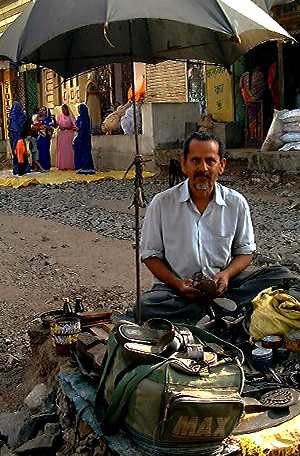
From Surat towards the Sea Surat is located to the south of Ahmedabad. I arrive there by train and hire a car with a driver called Max, who is as black as an African. I have brought along Tom Weber’s book on the Salt Marsch, my little computer and my camera. This trip must be registered thoroughly. I shall drive the final 50 kilometres of Gandhi’s Salt March along small roads from one village to the next, and visit the temples, overnight accommodations and other places the 78 marchers passed 71 years ago. We soon leave “development” and “civilisation” behind us. India is its villages, not its cities! Here it is pastoral and peaceful; the air is fresh. I can both see and hear the birds. In the small village of Dharam, I find a simple house, now a library, which has a statue of Gandhi erected in front of it....
Imagen-thumbnail-The-Transnational-1
LONDON – This is not the last tango in Belfast, whatever the hype of Sinn Fein. Sinn Fein and the IRA have a marked ability to suggest, even promise, a course of action but then the actual delivery becomes a now-you-see-it-now-you-don’t process. Still, the IRA proposal made earlier this week looks like the firmest and clearest promise yet to destroy their arm caches. And common sense suggests that in the end they will act to begin real disarmament before next week’s deadline, despite today’s qualms by the Unionists. Not only do the nationalists have the better part of the bargain in the Good Friday Agreement of 1998, everyone knows that the arms cache question is more symbolism than substance. As was shown with the bomb that wounded eleven people in west London last week dissident factions of the IRA have no trouble in making deadly bombs out of fertiliser and...