

Arie Pauil, Julie Hollar and Jim Naureckas
May 4, 2023
On the 20th anniversary of the US- and British-led invasion of Iraq, the New York Times continued to dedicate itself to a waffling narrative, one that writes out most of history and opts for a message of “it’s complicated” to discuss the disaster it can’t admit that it helped create.
On Saturday, the Times (3/18/23) published an article on its website headlined, “20 Years After US Invasion, Iraq Is a Freer Place, but Not a Hopeful One.” The next morning, the article (under the headline “Lost Hopes Haunt Iraqis, Two Decades After Invasion”) was featured at the top-right corner of its front page—making it one of the most prominent articles in the English-speaking world that day.
Originally published at FAIR on March 22, 2023

The article, by Baghdad bureau chief Alissa Rubin, began and ended in a Fallujah cemetery, and it certainly painted a gloomy picture of both present-day Iraq and the ravages of war. Yet the Times couldn’t help but balance the gloom with positive notes. Rubin quoted former Iraqi President Barham Salih explaining that there have been “a lot of positive developments” in Iraq. For instance: “Once [Saddam] was gone, suddenly we had elections. We had an open polity, a multitude of press.” Another of those positive developments, Rubin wrote, was “a better relationship with the US military.”
And yet, Rubin went on, “For many Iraqis, it is hard to appreciate the positive developments when unemployment is rampant.” She also pointed to the fact that “about a quarter of Iraqis live at or below the poverty line” and, above all, to “the increasingly entrenched government corruption.” (Today, Iraq shares the rank of 157 out of 180 countries on the Transparency International corruption index with Myanmar and Azerbaijan, as the Times noted.)
Rubin offered only glimpses of responsibility. Of the George W. Bush administration’s claims of weapons of mass destruction, she simply wrote, “no evidence to back up those accusations was ever found.” Of the power vacuum that Iran stepped into, Rubin wrote, “Abetting and expanding Iran’s influence in Iraq was hardly the intention of American policymakers in 2003.” The power-sharing government system the US installed “is regarded by many as having undermined from the start any hope of good governance,” she explained. “But Mr. Crocker and others said that at the time it seemed the only way to ensure that all sects and ethnicities would have a role in governing.”
Understating catastrophe
It’s perhaps an unsurprising framing, coming from a journalist whose reflections on Iraq in 2009 (11/1/09; FAIR.org, 11/3/09) included the observation that while Sunnis and Shiites in Iraq committed “horrific crimes,” and Kurds displayed “brutality,” the “Americans, too, did their share of violence.” But maybe, she seemed to suggest, Americans didn’t commit enough violence?

Among the worst they did was wishful thinking, the misreading of the winds and allowing what Yeats called “the blood-dimmed tide” to swell. Could they have stopped it? Probably not. Could it have been stemmed so that it did less damage, saved some of the fathers and brothers, mothers and sons? Yes, almost certainly, yes.
Though her present-day article did emphasize the deaths and loss suffered by Iraqis, the numbers Rubin offered represented the floor, not the ceiling, of estimates. She wrote that “about 200,000 civilians died at the hands of American forces, Al Qaeda militants, Iraqi insurgents or the Islamic State terrorist group, according to Brown University’s Cost of War Project.”
This only includes violent deaths, and only of civilians. A peer-reviewed study in 2013 estimated that more than 400,000 Iraqi deaths from March 1, 2003 through June 30, 2011 were directly attributable to the war, with more than 60% due to violence and the rest to other war-related causes.
Meanwhile, Opinion Research Business (Reuters, 1/30/08) used polling methods to estimate that, only five years into the war, “more than 1 million Iraqis have died as a result of the conflict in their country since the US-led invasion in 2003.”
And the New York Times didn’t mention another dark part of the Brown University study: The war helped create more than 9 million Iraqi refugees and internally displaced people. Also unreported at the Times: US war and sanctions left an estimated one in 10 Iraqis disabled (Reuters, 1/21/10). In other words, however bleak a picture it might have painted, Rubin’s piece understated the catastrophe.
Selling the case for war
Rubin also did not acknowledge that by the New York Times’ own admission (5/26/04), a year after the invasion, the paper had published numerous articles based on anonymous Iraqi informants that promoted false claims about Iraq’s pursuit of weapons of mass destruction.
The magnitude of the Times’ role in selling the case for the Iraq War is staggering. A few of the dubious articles about Saddam’s weapons program involved the infamous reporter Judith Miller (9/8/02, 1/23/03, 4/21/03), who today works at the conservative Manhattan Institute, writing pieces for City Journal about the superiority of Red State policies (3/1/23) and condemning “cancel culture” (6/6/21).
Many of Miller’s key pieces of disinformation were co-written with Michael Gordon, who remained a lead journalist for the Times for many years, continuing to relay the charges of anonymous US officials against official enemies (FAIR.org, 2/16/07; Extra!, 1/13). Now he’s doing much the same thing for the Wall Street Journal (FAIR.org, 6/28/21).
After Gordon and Miller dutifully transcribed the fabricated case that Iraq was pursuing a nuclear bomb—a story generated by the office of Vice President Dick Cheney—Cheney was able to go on Meet the Press (NBC, 9/8/02) and issue dire warnings about a nuclear-armed Iraq, citing “a story in the New York Times this morning” (FAIR.org, 3/19/07).

When UN weapons inspectors failed to find the nonexistent WMDs prior to the invasion, the Times (2/2/03) dismissed the lack of evidence; after all, “nobody seriously expected Mr. Hussein to lead inspectors to his stash of illegal poisons or rockets, or to let his scientists tell all,” correspondent Serge Schmemann reported.
Times reporter Steven Weisman (2/6/03) praised Colin Powell’s deceptive UN presentation as an “encyclopedic catalog that reached further than many had expected.” A Times editorial (2/6/03) called it “the most powerful case to date that Saddam Hussein stands in defiance of Security Council resolutions and has no intention of revealing or surrendering whatever unconventional weapons he may have.”
Explaining why journalists didn’t ask President George W. Bush critical questions about the evidence put forward as justification for war, Times reporter Elisabeth Bumiller (Baltimore Sun, 3/22/04) later explained, “No one wanted to get into an argument with the president at this very serious time.” (Bumiller is now the Times‘ Washington bureau chief.)
Deriding the opposition
Other New York Times pieces derided the world’s opposition to war, with correspondent Elaine Sciolino (9/15/02) mocking “old French attitudes” like those of President Jacques Chirac, who “made it clear that he doesn’t think it is the business of the world’s powers to oust leaders simply because they are dictators who repress their people.”

While doing its best to ignore massive protests against the war (FAIR.org, 9/30/02), the Times highlighted supposedly surprising supporters of invasion. Under the headline “Liberals for War: Some of Intellectual Left’s Longtime Doves Taking on Role of Hawks,” Kate Zernike (3/14/03) argued that “as the nation stands on the brink of war, reluctant hawks are declining to join their usual soulmates in marching against war.” It cited seven people by name as “somewhat hesitant backers of military might”—every one of whom is on the record as having supported the 1991 Gulf War.
On the eve of war, Baghdad correspondent John Burns (3/19/03) declared, “The striking thing was that for many Iraqis, the first American strike could not come too soon.” Burns was the reporter who could glean the feelings of Iraqis about the invasion by viewing them on the street from his hotel room:
From an 11th-floor balcony of the Palestine Hotel, it was not possible to hear what the driver of the red Mercedes said when he was pulled over halfway down the block, but his gestures conveyed the essence powerfully enough. “Get real,” the driver seemed to be saying. “Look at the sky. Look across the river. The old is giving way to the new.”
Invasion advocacy
Things were no better in the opinion section. New York Times columnist Thomas Friedman (4/27/03) said after the invasion, invoking Saddam’s repression, “As far as I’m concerned, we do not need to find any weapons of mass destruction to justify this war,” and later (9/18/03) accused France of “becoming our enemy” for opposing the invasion.

Ex-CIA analyst Kenneth Pollack (New York Times, 2/21/03), who serves at the conservative American Enterprise Institute and was praised by New Yorker editor David Remnick (1/26/03) as the most clear-thinking invasion advocate, wrote that because of Saddam’s “terrifying beliefs about the utility of nuclear weapons, it would be reckless for us to assume that he can be deterred.” While “we must weigh the costs of a war with Iraq today,” Pollack advised, “we must place the cost of a war with a nuclear-armed Iraq tomorrow.”
Even as the nation was still in shock from the 9/11 attacks, Richard Perle (New York Times, 12/28/01), a prominent neoconservative and then chair of the White House’s Defense Policy Board, demanded action against Iraq, because Saddam maintained an “array of chemical and biological weapons” and was “willing to absorb the pain of a decade-long embargo rather than allow international inspectors to uncover the full magnitude of his program.”
The Times even gave column space (1/23/03) to then–National Security Advisor Condoleezza Rice to say “Iraq has a high-level political commitment to maintain and conceal its weapons.”
It’s no wonder that the Times, despite its liberal reputation, is remembered in antiwar circles as a public relations arm of the Bush administration.
‘Bumbling into conflict’
Accompanying Rubin’s piece after the jump was an analysis by Max Fisher (3/18/23) and a spread of Iraq War photos (3/18/23). Fisher’s piece, headlined, “Two Decades Later, a Question Remains: Why Did the US Invade?” wondered:
Was it really, as the George W. Bush administration claimed in the war’s run-up, to neutralize an active Iraqi arsenal of weapons of mass destruction that turned out to not exist?
Was it over, as the administration heavily implied, suspicions that Saddam Hussein, Iraq’s leader, had been involved in the attacks of Sept. 11, 2001, which also proved false?
Was it to liberate Iraqis from Mr. Hussein’s rule and bring democracy to the Middle East, as the administration would later claim?
Oil? Faulty intelligence? Geopolitical gain? Simple overconfidence? Popular desire for a war, any war, to reclaim national pride? Or, as in conflicts like World War I, mutual miscommunication that sent distrustful states bumbling into conflict?
“I will go to my grave not knowing that. I can’t answer it,” Richard Haass, a senior State Department official at the time of the invasion, said in 2004 when asked why it had happened.
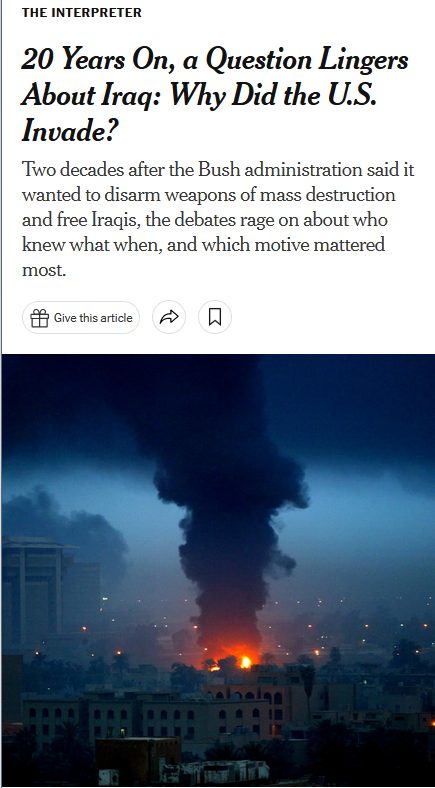
Ultimately, Fisher wrote, “The world may never get a definitive answer.” After a lengthy examination of various officials’ and scholars’ thoughts about the question, Fisher concluded that it comes down to “a mix of ideological convictions, psychological biases, process breakdowns and misaligned diplomatic signals.”
Designed to obfuscate
Like Rubin’s piece, Fisher’s piece seems designed to obfuscate any direct accountability for the devastation wrought by the war, leaning heavily on passive constructions and quotes, such as another from Haass: “A decision was not made. A decision happened, and you can’t say when or how.”
When Fisher asks, “Did the administration sincerely believe its rationale for war, or engineer it as a pretense?,” his conclusion—even after pointing out that the official rationale changed from Saddam Hussein’s purported involvement in 9/11 to his purported secret stash of WMD (and, later, to US democracy promotion)—is that “the record suggests something more banal”: that various senior officials wanted Hussein out “for their own reasons, and then talked one another into believing the most readily available justification.” It’s hard to see how talking each other into false justifications for pre-established goals isn’t far closer to “engineer[ing] it as a pretense” than it is to “sincerely believ[ing] its rationale.”
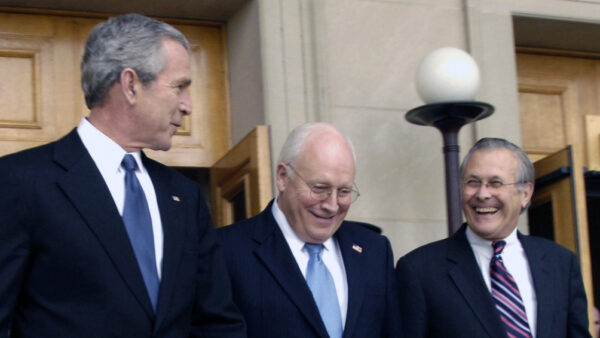
Later, Fisher writes, “Few scholars argue that Mr. Bush’s team came into office plotting to invade Iraq and then seized on September 11 as an excuse.” Again, this seems like splitting hairs at best. Fisher had just noted that neoconservatives represented by the Project for a New American Century (PNAC)—who later formed Bush’s inner circle—”now spoke for the Republican Party,” and that as far back as 1998, PNAC insisted that Hussein be removed from power. In a 2000 memo, PNAC suggested this might require “some catastrophic and catalyzing event, like a new Pearl Harbor.”
Fisher’s piece reiterates some of the most prominent myths about the invasion rationale. He claims that during the Clinton administration, “Mr. Hussein had ejected international weapons inspectors”—an error that the New York Times has repeatedly had to correct (2/2/00, 9/17/02, 10/4/03, 10/8/03; FAIR.org, 10/7/03). As news outlets correctly reported at the time but later consistently misrepresented (Extra! Update, 10/02), the UN withdrew its inspectors from Iraq on December 16, 1998, because the United States was prepari
